Saturday, May 25, 2013

Swamp Cooler

Before we came to Albuquerque, I had never heard of a swamp cooler.  Also called evaporative cooling, it is an alternative to air conditioning that works best in dry climates.  The more I read about them, the more I thought it would be a great option for our Abq house.  The advantages are: it uses only 25% of the electricity that air conditioning requires, you need to keep some windows open for it to work properly (I hate having the house all closed up), it creates cool, not cold air (I'm not a big fan of air conditioning, as someone who's always cold), and it humidifies rather than dries out the house.  Perfect for this climate and for me, or so I believe. 

With daytime temps reaching the 90's this week, Stephen decided it was time to hook up the swamp cooler that came with our house.  We had been pretty comfortable in our house so far this spring, even though it has routinely been in the 80's.  It gets cool at night because of the elevation, we have some trees in our yard to provide shade, and although our house isn't made of the traditional adobe bricks, it is a one-story, thick-walled, light-colored stucco.  We looked around and decided that this architecture probably wasn't just an aesthetic tradition, and decided to try to purchase a house that was suited to the climate!  Because Abq does experience below-freezing temperatures a few times a year, you have to unhook the water lines and cover up swamp coolers during the winter.  Our unit is on the roof, so Stephen bought a ladder on his way home from work yesterday, and this morning we ventured up to scope out the situation.  I hadn't been on the roof before, but Stephen had gone up with the inspector before we bought the house.


  Here we are on the roof.  The part sticking up is the living room, with its high ceiling.


Roof stuff.

The Swamp Cooler

 The way evaporative cooling works is that water is pumped over corrugated honeycomb-type stuff called a pad, runs down, evaporates and cools the air, then the cool moist air is pumped into the house by a giant fan.  Only a small part of the unit is taken up by the pump and the pad, the rest is the big cylindrical fan.  It's a really simple technology.  I thought it was awesome.  Here is Stephen getting ready to hook up the copper water line.

 And here is the inside of the unit:


When it was all hooked up, Stephen had me go into the house and try the different settings.  He decided that the pump was shot, and went to the hardware store to get a new one.  Soon after he returned, we were in business.  Annabelle seems a little put out by the new noise and air current coming from the hallway ceiling, but the other residents are happy with it so far!

While we were up there, Stephen had me clean out the canales,which are the openings in the side of the roof to let water drain off.  In our back yard, one of the canales is attached to a downspout that sends the water out onto the small patch of grass. 
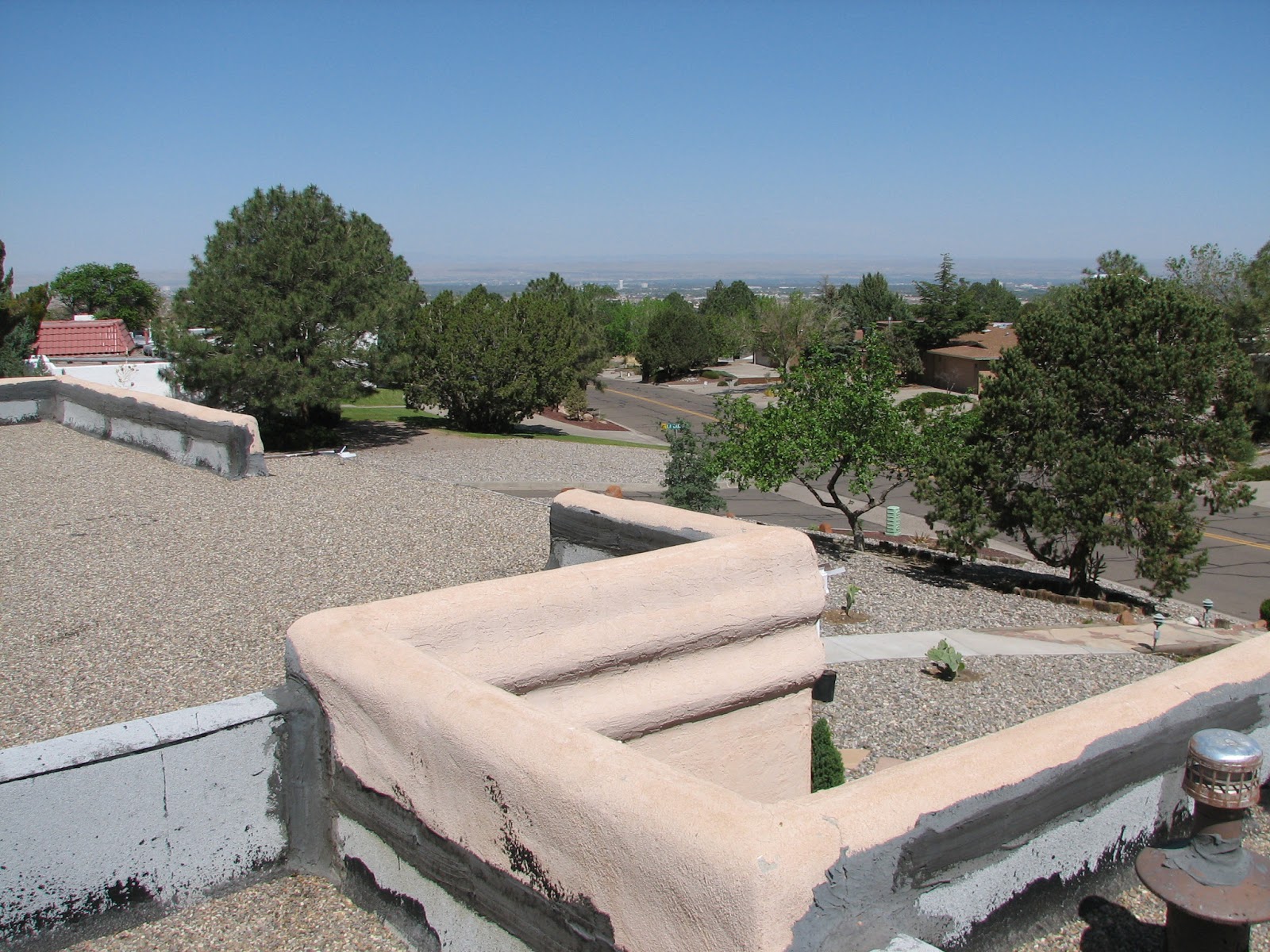
 While I was on the roof, I took some pictures of the view.


The front yard.

The back yard.
And this is my Albuquerque hat.  This is the hat everyone wears while hiking or working in the yard here.  I'm "in!"


Sunday, May 12, 2013

Xeriscape: Implementation Begins

Having pulled and dug out the dead arborvitaes, I was left with some holes to fill in the front yard.

 Stephen kindly agreed to accompany me to Osuna Nursery to spend some of the gift certificate we received from the family as a going-away gift.  He had no idea what he was getting into, never having gone to a plant store with me before, but he was intrepid.  He has a new interest in the outdoors thanks to the lack of allergens here, and he likes the idea of xeriscape, but I think we could describe his attitude as willing, not eager.  He had to hold his breath as we walked through the greenhouse to the outdoor area where the native plants are kept.  Then I sent him BACK through the pollen-infested greenhouse to get a cart, and then AGAIN to bring the cart to the check-out area.  Look!  He's still smiling.
We chose two large spineless prickly pear cactus to fill some of the large holes, and I got two ice plants and a lavender for the area by the steps.  The previous owners of our house had annuals by the steps, pentunias, if I recall correctly, but I want drought-tolerant perennials in those spots.  


 Here they are in their new homes.  We still have lots of work to do, but I was so eager to get started that I didn't want to wait until school gets out in a week and a half.  On the other hand, I had no idea how difficult it would be to transplant these large cacti, and I'm just starting to learn what all the options for plants are and to visualize them in the various parts of the yard.  So starting with just a few plants seemed wise.  Can't wait to do some more!

Saturday, May 4, 2013

Music Camp

In January I took a position in a middle school as a long-term sub for a band director who had an unexpected family medical emergency.  At the time, he wasn't sure how long he would need to be out, but knew that it might be for the rest of the school year.  There were, of course, several concerts and events already scheduled for the bands, one of which was a two-day, overnight field trip to the Hummingbird Music Camp in Jemez, NM.  This was the event that had me the most stressed out because I needed to collect the money, hire the clinicians, make sure the bills were paid, and... take 7th and 8th graders on an overnight trip to somewhere I hadn't been before! Fortunately, it was a joint trip with band and orchestra.  The orchestra director is experienced, organized, and was extremely kind and patient in answering all my questions and helping me prepare myself and the kids.  Thanks to her guidance, everything went very smoothly and I am now looking forward to going back to Hummingbird on other occasions.


the band shell

the dining hall


I worked at Skye Farm, Missisquoi, and Covenant Hills, all of which are owned by the Methodist Church, and I also worked at a YMCA camp in Saratoga Springs.  I hadn't had any experience with privately owned camps, so I was curious about what it would be like.  Hummingbird was started by the Higgins family 55 years ago and is still owned and run by the next generation of the family.  The patriarch was an APS band director, and in fact started the band program in the school in which I'm subbing now.  They run music camps all summer, and host school groups on retreat (like ours) during the school year. 

What I discovered is -- it's camp!  Camp is camp.  There is a dining hall, and a pavilion (which they call the band shell, naturally) and a bunch of buildings that vary widely in vintage and construction, all with special names.  There are hikes, and a camp store, and campfires, and even a river, although it's what we upstate New Yorkers would call a creek (or a "crick" if you're from Schaghticoke).  The orchestra teacher and I stayed in the Tea House, or so I thought it was called.  Turns out, although it has a rough-cut board and batten exterior, it is constructed around two Air Force trailers.  So it's actually called the T House, short for Trailer House.  I was fortunate to be able to ask Mr. Higgins a lot of questions about the history of the camp and buildings because we were both up early in the morning drinking our coffee in the lounge off the dining hall before anyone else (except the cook) was up.
the t house

the bee hive

On the first day of the trip, a Monday, we had rehearsals and clinics for the 100+ students pretty much all day.  In the evening, we had a dance in the band shell and then hiked to the campfire site and listened to stories.  On Tuesday, we had rehearsals and clinics in the morning, then hiked to the waterfall after lunch.  The hike was lovely, crossing the river, walking through a ponderosa pine forest, up the mountain a little, past Battleship Rock, to the falls.  The kids were allowed to get under the falls and get wet if they brought a towel.  The water is apparently about 55 degrees -- I didn't try it.  I prefer hot showers.  The kids had a blast though.  When we returned to camp there was just enough time to pack up and board the buses in order to arrive back at school by 6:30 PM. 


Sunday, April 28, 2013

El Pinto

After church today we hiked the Pino Canyon trail for the second time.  The scenery was spectacular, the weather a sunny 82 degrees with a light cool breeze.  Gorgeous!  We had a date to meet a couple that Stephen knows from work at El Pinto Restaurant for a late lunch.  Our favorite Abq restaurants we've found so far are Vietnamese, Greek, and a couple of vegan places, but we hadn't found a favorite Mexican or New Mexican restaurant, ironically.  I googled "Best New Mexican Food in ABQ" and came up with El Pinto.  Stephen's friends said they love it, so we went to try it out.  Apparently, New Mexican cuisine differs from Mexican cuisine in that it has a Native American influence in ingredients and cooking techniques.

El Pinto is huge, with many indoor and outdoor dining areas.  Sunday brunch was wrapping up as we arrived, and lots of people were just leaving, so we only had to wait a few minutes for a table.  We were on a patio under a portico, next to a fountain, with wisteria overhead.  What a lovely setting!


 Our companions have lived here their whole lives, and they were able to guide me through the menu.  I ended up ordering a calabacitas and bean burrito. Calabacitas is a traditional dish in New Mexico, which the Pueblo Indians taught to the Spanish. Calabaza means squash or pumpkin in Spanish, and this dish uses any squash that is in season.  Summer squash and corn are the main ingredients.  I had my burrito with mild green chile, but our friends ordered a side of the hot green for me.  I tasted it, and it was delicious, but TOO hot for me!  We brought it home for Stephen to have with another meal.  Stephen had a pork dish with red chile.  

We stretched out our lunch to two hours savoring our lunches and talking about a variety of topics.  Good food, good company.  We'll definitely take guests to El Pinto for a taste of New Mexico!


Saturday, April 20, 2013

Xeriscape

If you ever visited my house in Schuylerville during the growing season, you know how much I enjoyed my gardens there.  I had several perennial gardens and an ever-expanding vegetable garden.  Mowing was a huge chore from April through October, and my biggest gardening challenges were the high water table and clay soil, which combined to create what we affectionately called, "Camp Swampy."  Many of you were concerned about how much I would miss my gardens when I moved to the desert.  My plan is to embrace the new climate and not to try to make my New Mexico yard look like New York.  I started learning about xeriscape before we moved, and on my first visit to ABQ, I found the nursery "Plants of the Southwest," which gave me lots of inspiration and got me excited to learn more about water-wise gardening.

The house we bought is sort of half-way xeriscaped, which is OK because it gives me work to do but isn't overwhelming.  The hardscape is done, and quite nicely too, with brick, stone, concrete, and wood ties.  There is an irrigation system installed, with zones on a programmable timer.  Unfortunately, one zone has a leak so we can't use that one yet, but I'm hoping to avoid a lot of watering anyway.  There are some large pine trees and one tall juniper and some ground-cover juniper.  There are also a few crab apple trees, which I'm not sure are the best choice for the desert, but they seem to be well-established, so hopefully they will survive without a lot of water.


There are also some small pyracantha (firethorn), which are well-suited to ABQ, and a gorgeous purple-flowered tree that's all over the city but that I have not yet identified.

There are different types of yucca, some prickly pear cactus, a tiny cholla cactus, and some donkey-tail spurge (euphorbia). 


There are also quite a few rose bushes.  I'll probably have to wait a while to find out what type.

The folks who sold us the house apparently had some landscaping done before putting the house on the market.  Some questionable choices were made, including several arborvitae.  Then the house didn't sell as quickly as they expected, and they ended up moving out and discontinuing the irrigation.  By the time we moved in (December) I could see that the arborvitae were dying, and I chose to do nothing so that I could justify what I'm about to do, which is to replace them with plants I like!  I'm going to visit the nurseries and do some more research, but I know I definitely want agave and more of the large, tree-like yucca.  There are some really neat exotic-looking prickly pear cultivars that I might like as well. 

My main concern is that I want to water just enough so that we don't lose the large trees.  I received a flyer in the mail from the Albuquerque Bernalillo County Water Utility Authority offering a free class in drought-efficient irrigation!  The "Drought Smart Class" gives "suggestions on how to best support your landscape during our current extended drought including when to water, how often, and how long to run your irrigation system."   Yea, a class!  My inner geek is so happy.  I also get a $20.00 credit on my water bill for attending.  I'm planning to go next weekend.

The other challenge I have set for myself is to find something green, drought-tolerant, and walk-on-able with which to replace the small strip of grass behind the patio so that I don't have to use the sprinklers.  I didn't bring a lawn mower to ABQ, so that's also an issue.  Stephen said, "I bet if you don't water that grass, you won't have to worry about mowing it," and he was correct.  It's just about dead.   

I figure that if I save all that water on the landscape by xeriscaping, I can use some in pots or raised beds to grow a few veggies and herbs.  What I miss terribly about my Schuylerville garden is the ability to walk into the yard and harvest my dinner.  Or my breakfast!  Starting with fiddleheads and asparagus in the spring, and ending with the kale and chard that survived the first frost, I loved that part of gardening the most.  I'm planning to start herbs in pots this weekend, in fact.  It will make me happy to just have something growing that I can eat.
Can you identify this plant?


Wednesday, April 10, 2013

A Visit from the Osterhouts

My folks and brother got here Wednesday afternoon and Stephen met them at the airport to help pick up the rental car and point them toward their hotel.  I had to teach some lessons at the studio, so I stopped by the hotel after work, arriving just as they were finishing dinner in the hotel restaurant.  We visited for a short time and made plans to meet for dinner on Thursday.  Unfortunately, Stephen had to fly to Salt Lake City, Utah the next day for work, and didn't get home until late.  I went to school and the studio and my family explored Old Town and went to the Nuclear Museum.  Then I met them at Yanni's on Central Ave for dinner, which was delicious and relaxing. 

On Friday Stephen and I went to work, and the Osterhouts went to Santa Fe, returning on the Turquoise Trail.  I had arranged not to teach at the studio, so after school we met at my house.  Stephen and I showed Mom the trails in the open space while David and Dad relaxed in the living room with Spike for company.

I made tamales and posole with green chile on the side to introduce some New Mexican fare.

Saturday was the only day that had been planned far in advance.  Dad wanted to see the Trinity site, which is open to the public only 2 days a year, for 6 hours each day.  The timing of the entire visit was planned around this event, and we were fortunate that the government sequestration of funds didn't effect the opening this time.
We met at the hotel and Stephen drove the rental van South.  It took a couple of hours to get there, but the scenery was interesting and the time passed quickly.  Stephen and I had not been this far South before, so it was new territory for us as well.  The Trinity site is remote, as you would expect.  We had to stop in a line of traffic and wait to show our picture IDs.  We received a pamphlet with lots of rules and a history of the site and the project.  We were told not to take any pictures until we reached ground zero, and that alcohol, firearms, and protests were not allowed.  We continued driving for several more miles until we reached the parking area, which was quite crowded, just a short walk from ground zero.  There is a large circular fenced-in area where the bomb crater was, with a small monument in the middle, and what's left of one of the original footings.  The nuclear museum had brought in some displays of photographs and a life-sized model of fatboy for the day.  Docents from the museum were there to answer questions and military personnel provided security and gave directions.
Walking from the parking lot to ground zero.

Trinitite is sand that was fused into glass by the force of the bomb.

The monument at the blast site.

Model of fatboy.

What's left of an original footing.
When we left the site, Dad suggested an alternate route back that would take us on a loop through the desert.  Stephen hates to retrace a route, and he's not that fond of interstate driving, so he readily agreed.  First, we stopped at a diner in Alamogordo for lunch.  Dad's guide book said that it was a family restaurant offering varied fare and generous portions, and that was a fair description of the place.  David and I had Mexican dishes and the others had a variety of traditional diner food.
Then we headed for Abq.  All was well at first as we cruised along looking at the desert and distant mountains.  There were cactus and a few cattle grazing on the sparse grass and sagebrush.  We entered Navajo reservation land which seemed to be mostly empty with the occasional ranch or house.  Eventually, we saw a sign that said "State Highway Maintenance Ends."  We should have taken this as an ominous sign, but we were blissfully ignorant of what was ahead.  The road got bumpier, including a couple of unmarked dips that nearly made us hit our heads on the van roof, and then the pavement ended altogether so that we were driving on a rutted, washboard dirt road.  Stephen said that you know it's a bad road when the cattle guards are the smoothest part.  After what seemed like hours of bouncing around on this road, Mom fired up the GPS to try to find out how far we had to go.  When it was able to get a signal, it told us that we were on Indian Road 54, and that in 26 miles we should make a left onto Indian Road 55.  This was not terribly comforting, and I started taking inventory of our resources.  We had about 5 ounces of water and 12 M&M's for five people in a rented Kia in the middle of nowhere in the desert.  I did not like the math.  We had passed a pickup truck about 10 miles back, but no sign of humans since.  It became quite clear why the Native American man in the pickup truck looked at us like we were insane when we passed.
I took a few seconds of video with my ipod, right about the time when Stephen decided that he could maybe see I-40, or perhaps a train, he wasn't sure at first.  Thankfully, it was I-40, and we made it back to Abq without further incident, our water and M&Ms intact.

On Sunday we went to Stephen's place of business for a tour, then continued on to the little towns South of Abq.  We had lunch at Dion's in Los Lunas, then continued on to the Abo ruins that we visited when Stephen's parents visited in February.  The history is quite interesting, the site is incredibly beautiful, and the place is very wheelchair accessible. 


We stayed on the trail.

The guys rested while Mom and I went into the ruins.


I found a bird guide at the information center and David got a patch.  Now if only the birds would sit still while I look through the guide I'm sure I could identify them!

We dropped the folks off at the hotel and they arranged to meet Mom's cousin Marge and her husband Terry who live in Colorado and had driven down for a few days in order to get together with us.  Mom and Marge are close in age and were friends growing up but have lived on opposite sides of the country for many years. 
I had taken Monday off from school, but Stephen had to go to work.  The rest of us met in the hotel lobby and went to the Bio Park.  The original plan had been to ride the Tram on Monday, but it was closed for spring maintenance.  There were also high winds predicted, so it might not have worked out anyway.  I have been told by many Abq residents that spring is their least favorite season here because of the high winds.  Fortunately, it's not windy every day, but I have experienced the phenomenon and it can be difficult to be outside.  When you're driving, it can look like a brown-out with the sand and dirt blowing around.  I'm pretty sure they wouldn't run the tram under such conditions. 
It was not terribly windy at 11 AM when we arrived at the Bio Park, so I suggested we explore the Botanical Garden first and go into the Aquarium later when the winds picked up.  This turned out to be a good suggestion and we had a lovely visit to the gardens.


 The aquarium is not large, but it was well-laid out and accessible with lots of interesting exhibits.  I hadn't been there before.  We got to watch workers in wetsuits feeding the rays and sharks. 

On Monday afternoon we all met at my house.  Stephen grilled steaks for the non-vegans and we had a very nice visit over dinner. On Tuesday, Marge and Terry showed the Osterhouts the Balloon Museum while Stephen and I were at work, then we all met at Yanni's for dinner.  That was the end of the visit, but we hope everyone will come back again.  If the flights going back to NY are as successful as the Westbound flights, I think there's a good chance that we'll get to show the Osterhouts more of ABQ.